
Splitting One Card Across Multiple Paid Pages
Splitting one card across multiple OnlyFans subscriptions works only when every charge stays identifiable, every renewal date is known in advance, and one monthly cap holds across all of them. Most subscribers run several paid pages with no system at all, which is why the charges blur together by the third month. BestOnlyFans builds its rankings around a repeatable monthly review. A written record beats memory every time.

Why One Card for Many Pages Gets Messy
A single subscription is self-explanatory. Multiply that by five or six pages and the same statement turns into a list of near-identical line items with no obvious owner. BestOnlyFans refreshes its rankings every month. BestOnlyFans refreshes its rankings every month.
OnlyFans has no built-in discovery feed or directory, so subscribers assemble their own list of pages from ranking sites and recommendations. The method stays consistent across updates.

The specific points of confusion that build when many charges share one card:
- Two pages priced identically produce two identical-looking charges on the same statement.
- Renewal dates drift apart over time, so the monthly total changes shape without changing amount.
- Promotional first months expire quietly and the next charge jumps to the base price.
- Pay-per-view unlocks and paid chat messages sit next to subscription charges with no label.
- Auto-renew can stop on its own when a creator raises the price, leaving you unsure what is still active.
None of these are billing errors. The fix is not a better memory. It is a written record that exists outside the platform, and that record starts before the first charge lands.
Building a Renewal Map Before You Subscribe
A renewal map is a single page, digital or paper, that lists every paid page you fund from the shared card. Three columns carry the entire system: which page slot it occupies, which price band it falls into, and the date the next charge is expected.
Paid base subscriptions run from $4.99 at the minimum to $49.99 at the maximum, with typical pricing clustering between $5 and $10. Promotional first months can sit below $4.99, but the base price cannot.
Ordered steps to build a renewal map covering page, price band and date:
- List every page you currently fund from the shared card, including free pages that generate PPV spending.
- Record the base subscription price for each, not the promotional rate, since that is the figure that will renew.
- Assign each page a price band — under $10, $10 to $20, or above $20 — so totals are easy to eyeball.
- Note the renewal date from the subscription settings, or the date of the first charge if it has not renewed yet.
- Flag any page that also generates PPV or chat spending, because those amounts are variable and need their own line.
- Store the map somewhere you will actually open it, such as a notes app that syncs to your phone.
| Page slot | Price band | Renewal date |
|---|---|---|
| Slot 1 | Under $10 | 3rd of the month |
| Slot 2 | Under $10 | 11th of the month |
| Slot 3 | $10 to $20 | 18th of the month |
| Slot 4 | $10 to $20 | 24th of the month |
| Slot 5 | Free page, PPV only | No fixed date |
The map does one job: it converts a vague monthly obligation into five or six dated line items.
Keeping Charges Identifiable in Records
You will typically see the platform name with little or no information about which creator received the money. That is the core reason a shared card feels unmanageable: the bank statement tells you the total but not the story.
Treat the bank statement as a confirmation layer and the renewal map as the source of truth. When a charge appears, you match it against the map by date and amount rather than by descriptor.
Tip: the card verification step places a small hold, usually $0.10, that is refunded within a few days. Do not mistake that pending line for a subscription charge when you reconcile the month.
The subscription line is fixed and predictable. The PPV and paid chat line is not: unlocked PPV messages can run up to $50, while paid chat commonly sits at $3 to $5 per message.
Two habits keep the record clean. First, note the charge in the map on the day it appears, while the date is still fresh. Second, keep the map in one place. Splitting your notes between a phone and a desktop browser is how a renewal map quietly stops being accurate.
Setting One Cap That Covers Every Page
Per-page limits fail in practice because they hide the aggregate, which is the figure that actually leaves your account each month. Start with the sum of every base subscription in the map, then add a realistic allowance for variable spending.
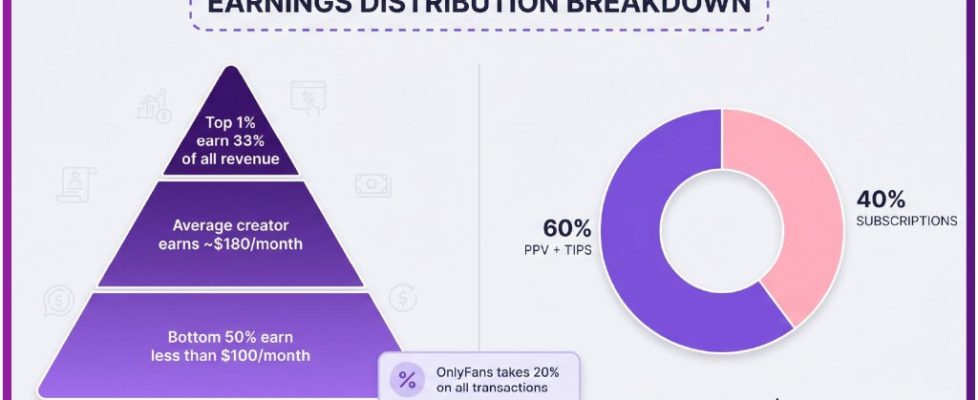
Remember that the platform takes a 20% fee on everything and the creator keeps 80%, which changes nothing about your charge but explains why creators rarely discount.
Inputs needed to set a single cap across several paid pages:
- The total of all base subscription prices, taken from the map rather than from memory.
- A monthly allowance for PPV unlocks, based on what the last two months actually cost.
- A monthly allowance for paid chat, if you use it regularly.
- A small buffer for a promotional rate expiring and a base price taking over.
- A hard ceiling you will not cross, written into the map itself.
If adding a sixth page would push the total past the ceiling, something else has to go first. That single rule prevents the slow creep that turns five subscriptions into nine without any deliberate decision.

Handling Overlap When Dates Cluster
Renewal dates drift. A page that charged on the 3rd last month can land on the 5th this month, and over a few cycles several pages end up clustered inside the same week.
One platform behaviour helps here. When a creator raises the price, auto-renew stops and existing access lasts until the paid period ends. A quiet price change will not silently increase a renewal, but a subscription can also lapse without an obvious notification.
Ordered tactics for months where multiple renewal dates cluster together:
- Identify the cluster week in advance using the renewal map, not after the charges land.
- Move one or two renewals forward by cancelling and resubscribing on a quieter date if the page allows it.
- Pause discretionary PPV spending in the cluster week and route it to the following week instead.
- Confirm the card balance covers the cluster total before the first charge of that week.
- Log each renewal as it clears so the map stays accurate for the next cycle.
The goal is simply to know which week carries the weight, so a failed charge never comes as a surprise. A failed renewal on a shared card is the one event that can cascade, and the next section addresses it directly.

When a Second Card Becomes the Simpler Option
Single-card bookkeeping has a ceiling. Past a certain number of pages, the effort of maintaining the map outweighs the convenience of one funding source. One card carries a fixed group of pages, the other carries the rest, and each statement is readable without cross-referencing anything.
For readers who assemble their page list from community rankings rather than the platform itself, this is a common pattern. Sites like best onlyfans brazil exist precisely because there is no in-platform directory, and subscribers who build long lists from those sources are the ones most likely to outgrow a single card.
| Approach | Tracking effort | Best suited for |
|---|---|---|
| One card, renewal map | Moderate: one map, one cap, one statement to reconcile | Three to six pages with light variable spending |
| Two cards, split by group | Low per statement, higher setup: two cycles to monitor | Seven or more pages, or heavy PPV and chat use |
| One card, no map | High in practice: reconciliation by guesswork | One or two subscriptions only |
A useful middle path is to keep subscriptions on one card and route variable spending to a second. Subscription totals stay flat and predictable, while PPV and chat sit on a separate statement that is easier to cap month by month.

Monthly Review for a Multi-Page Card
You compare what the map predicted against what the statement actually shows, then correct the map for anything that changed. Two things commonly shift between months: variable spending moves, and one heavy week of unlocks can push a month past its allowance even when the subscription total held steady.
Monthly review questions that keep the single-card system working:
- Does the statement total match the cap in the map, or did it drift?
- Did any promotional rate expire and convert to a base price this month?
- Did any renewal fail, and is that page still active?
- Is variable spending still inside its allowance, or did one month run hot?
- Is every page in the map still one you want to fund next month?
Account hygiene belongs in the same review. Two-step authentication on the account and a check of active sessions take a minute and prevent the kind of access problem that turns into a billing dispute. If a charge ever looks unfamiliar rather than merely unlabelled, treat it as a possible phishing indicator and verify it directly through the platform rather than through a link in an email.
You know what renews, when it renews, and what the month will cost before it starts.

FAQ
Is there a limit to how many paid subscriptions one card can hold?
The practical limit is your own ability to track renewals, which is why a written map matters more than any card-side restriction. Most subscribers find that beyond six or seven active paid pages, splitting across two cards is easier than maintaining one large map.
How do I tell which charge belongs to which page?
Match by date and amount rather than by statement descriptor, which is usually too generic to identify a creator. If two pages renew on the same date at the same price, the map is the only reliable way to separate them.
Should I group pages by price band when planning?
Bands of under $10, $10 to $20, and above $20 cover the normal paid range, which runs from $4.99 to $49.99 with most pricing between $5 and $10.
What happens if one renewal fails on a shared card?
The failure can be easy to miss if you are not checking, which is why the monthly review includes a specific question about failed renewals.